Are you confused by VAT rules in the United Kingdom? VAT, or Value Added Tax, affects food, education, and healthcare. It’s a challenge for businesses and consumers to understand.
VAT rules are more than just taxes. They show how the government balances making money with social needs. Each sector gets treated differently, which changes prices and how we buy things.
This guide will help you understand VAT rules in key areas. It’s for business owners, professionals, and anyone interested in taxes. You’ll learn how taxes affect your daily life.
Exploring VAT rules will show you how certain items and services are taxed. You’ll see the difference between zero-rated, exempt, and standard-rated. This knowledge will help you navigate the UK tax system better.
Understanding VAT in the United Kingdom
Value Added Tax (VAT) is a key part of the UK’s tax system. It’s a consumption tax that affects businesses and people in many areas. Knowing about VAT helps you make better financial choices.
The UK’s VAT rules help the government get money while being fair to all industries. Understanding VAT is important for smart financial planning.
What is Value Added Tax?
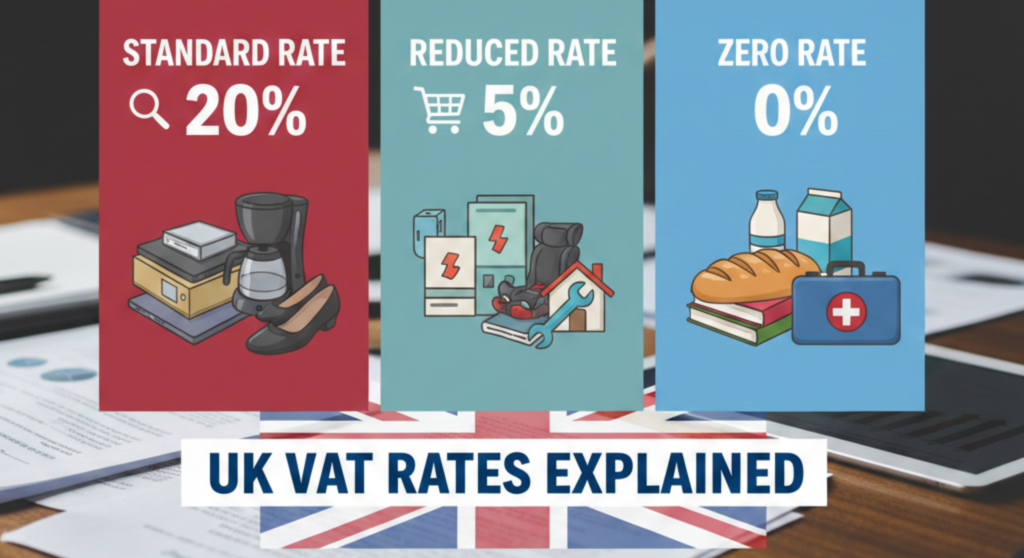
VAT is a tax on most goods and services in the UK. It’s collected at each step of making and selling things. The UK has different VAT rates:
- Standard rate: 20%
- Reduced rate: 5%
- Zero rate: 0%
How VAT Applies to Different Sectors
VAT rules change a lot between different areas. Important sectors like food, education, and healthcare get special VAT rules.
| Sector | VAT Treatment | Typical Rate |
|---|---|---|
| Food | Often zero-rated or reduced | 0% or 5% |
| Education | Mostly exempt | 0% |
| Healthcare | Mostly exempt | 0% |
The UK’s VAT rules show how the government supports key services while collecting taxes. Businesses need to follow these rules closely to stay out of trouble.
VAT Rules for Food and Beverages
Understanding VAT rules for food and drinks in the UK can be tricky. The tax system has different rates for various food types. It’s important for both businesses and shoppers to know these rules.
In the UK, VAT rules for food are detailed. Most everyday food items get a break on tax, with many being taxed at zero. This makes essential foods more affordable for everyone.
- Zero-rated items typically include basic groceries
- Standard-rated products often include prepared meals
- Exempt categories cover specific food-related services
Restaurants and shops selling food need to get these VAT rules right. The differences can be small but affect the tax rate. This means prices and taxes can vary a lot.
Some important things to remember about food VAT include:
- Temperature of the food
- Method of preparation
- Packaging and presentation
- Purpose of the food item
Businesses must stay informed about current vat rules to avoid potential penalties and ensure accurate tax calculations. The rules are complex, so getting expert advice is often a good idea.
Zero-Rated VAT on Essential Food Items
Learning about zero-rated VAT can save you money on food in the UK. The HMRC has clear rules on which foods get zero-rated VAT. This helps both consumers and businesses save a lot.
Which Foods Qualify for Zero Rating?
Many basic foods get zero-rated VAT. These include:
- Bread and flour
- Meat and fish
- Fresh fruits and vegetables
- Milk and eggs
- Cereals and grains
- Most unprepared food products
The food must be in its original state and meant for eating. Raw ingredients and unprocessed food items usually get this tax break.
Exceptions to Zero-Rated Food
Not every food item gets zero-rated VAT. Some are taxed at the standard rate, like:
- Hot takeaway meals
- Alcoholic beverages
- Confectionery
- Crisps and savoury snacks
- Ice cream
- Soft drinks and sports drinks
The way food is prepared and its temperature can change its VAT status. Foods that are heated for eating right away or are seen as luxury items pay standard VAT. This sets them apart from basic, zero-rated foods.
Standard-Rated and Exempt Food Products
Understanding VAT exemptions for food products can be tricky. It’s important to know the difference between standard-rated and exempt items. This helps with pricing and following HMRC rules.
In the UK, food products are divided into different VAT groups. This affects their price and tax status. Standard-rated foods have a 20% VAT, making them more expensive for buyers.
- Standard-rated products include most prepared meals and hot foods
- Confectionery and chocolate-covered snacks typically attract the full VAT rate
- Catered food and restaurant meals are generally subject to standard VAT rates
The Jaffa Cake case shows how VAT rules can be complex. HMRC decides on VAT based on small details like temperature and packaging.
Exempt food items are rare. Most are either zero-rated or standard-rated. Your business needs to check each product’s VAT status to avoid fines.
Managing VAT exemptions well means keeping good records and knowing your products. It also means staying up-to-date with HMRC rules.
VAT Regulations for Educational Services
Understanding VAT exemptions for schools and colleges can be tricky. Knowing the rules helps manage finances better.
The UK has special VAT rules for educational services. These rules decide when you don’t pay VAT and when you do.
Exemptions for Eligible Educational Bodies
Some educational groups get VAT exemptions. They must meet HMRC’s criteria. These include:
- Recognised schools and academies
- Higher education institutions
- Registered charitable educational organisations
- Publicly funded training centres
When Education Services Are Subject to VAT
Not every educational service gets VAT exemptions. Commercial training and private schools might have to pay VAT.
| Service Type | VAT Treatment |
|---|---|
| Public School Education | VAT Exempt |
| Private Professional Training | Standard VAT Rate |
| Vocational Courses | Dependent on Provider Status |
Getting VAT exemptions right needs careful thought. You must understand your service and how it’s structured.
Understanding VAT Thresholds for Education Providers
Understanding VAT thresholds is tricky for UK education providers. The VAT registration threshold is £85,000 of taxable turnover in 12 months. It’s key for schools to handle their finances well.
Not all income affects VAT thresholds. Exempt supplies, like educational services, don’t count. Schools and colleges must track their income types carefully.
- Exempt income does not contribute to VAT thresholds
- Standard-rated and zero-rated supplies count towards the threshold
- Commercial activities can trigger VAT registration
Even with mostly exempt income, education providers might need to register for VAT. Income from room hire, sales, or consultancy can exceed the threshold. Voluntary registration can sometimes offer financial advantages, like reclaiming VAT on purchases.
It’s vital to watch your turnover closely. Partial exemption rules affect your VAT reclaim. Getting advice from a tax expert can help you understand VAT rules better.
Healthcare Services and VAT Exemptions
Understanding VAT exemptions in healthcare can be tricky for doctors and health groups. It’s key to know the rules well to follow HMRC’s guidelines.
Medical Treatments Qualifying for VAT Relief
In the UK, some medical services don’t pay VAT. This includes treatments given by registered doctors. These services include:
- Diagnostic services
- Disease prevention treatments
- Medical consultations
- Therapeutic interventions
Medical Supplies and Equipment VAT Considerations
VAT rules for medical gear are different. Some items get special tax treatment:
- Prescription medicines are zero-rated
- Disability aids often qualify for reduced rates
- Specialised medical equipment may have different VAT classifications
Healthcare providers need to keep track of VAT exemptions. This helps with financial management. Getting advice from a tax expert can help understand the rules better.
Always consult with a qualified tax professional for personalised guidance on VAT treatment in healthcare services.
VAT Registration Requirements for Healthcare Professionals
Understanding vat registration for healthcare professionals can be tricky. Knowing when and how to register with HMRC is key. Healthcare businesses often face different VAT rules than others.
Healthcare workers should think about a few important things when deciding on vat registration:
- Turnover threshold of £85,000
- Types of services provided
- Exempt versus taxable supplies
- Potential financial benefits
Whether to register for VAT depends on several factors. Many healthcare services are VAT-exempt, so you might not need to register right away. But, if you offer standard-rated services or sell goods, you’ll need to register when your taxable turnover hits £85,000.
Choosing to register for VAT voluntarily can be beneficial for some healthcare businesses. It lets you claim back VAT on business costs, which could boost your finances. But, it’s important to weigh your situation carefully and consider the tax effects.
Keeping accurate records is vital for vat registration. You’ll need to keep detailed financial records, track your turnover well, and send VAT returns to HMRC regularly. Getting help from a professional accountant can make this easier.
HMRC Tax Guidelines and Compliance
Understanding HMRC tax guidelines is key. VAT rules can be tricky, especially in food, education, and healthcare. Keeping up with new rules is vital to avoid fines.
Important parts of HMRC tax guidelines for VAT include:
- Maintaining accurate financial records
- Charging correct VAT rates
- Submitting timely VAT returns
- Understanding sector-specific regulations
The HMRC offers lots of help to grasp VAT rules. They have:
- VAT Notice 701/14 for food-related businesses
- VAT Notice 701/30 for educational services
- VAT Notice 701/57 for healthcare professionals
It’s important to keep up with tax changes. VAT rules can change due to laws, court decisions, and HMRC updates.
| Compliance Area | Key Requirement |
|---|---|
| Record Keeping | Maintain detailed financial documentation for 6 years |
| VAT Returns | Submit quarterly or monthly returns electronically |
| Penalty Avoidance | Ensure accurate reporting and timely submissions |
If unsure about VAT, get expert advice or ask HMRC for advance clearance. Being proactive in following rules can avoid big financial problems.
Navigating VAT Returns and Record Keeping
Managing vat returns is complex for businesses in food, education, and healthcare. It’s key to understand VAT reporting well. This helps avoid penalties from HMRC.
Preparing VAT returns needs focus and a clear plan. Businesses must be organised and keep accurate records. This makes tax reporting easier.
Filing Your VAT Returns Accurately
When filing vat returns, follow these steps:
- Calculate your total sales and purchases
- Determine your output and input VAT
- Categorise supplies correctly (standard-rated, zero-rated, or exempt)
- Use compatible digital software for Making Tax Digital (MTD)
VAT returns are filed quarterly with strict deadlines. Digital submission is now a must. You need HMRC-approved software for vat returns.
Maintaining Proper Documentation
Keeping good records is vital for VAT calculations. You must hold onto financial documents for at least six years. This includes:
- Sales and purchase invoices
- Credit notes
- VAT account records
- Supporting documentation for special VAT treatments
Each sector has its own record-keeping needs. Food businesses must justify zero-rating, education providers need evidence of exempt status, and healthcare organisations should maintain professional qualification records.
| Sector | Key Documentation Requirements |
|---|---|
| Food | Proof of product classification |
| Education | Exempt supply evidence |
| Healthcare | Professional qualification records |
By sticking to these tips, you can handle vat returns well. This keeps you in line with HMRC rules.
Recent VAT Rate Changes and Their Impact
Understanding VAT rate changes in the UK can be tough for businesses. Recent updates have hit food, education, and healthcare hard. Financial managers and business owners need to pay close attention.
The COVID-19 pandemic led to temporary VAT rate changes. These have now been reversed. It’s vital to grasp these changes to stay financially compliant and plan ahead.
- Temporary VAT reductions in hospitality and tourism sectors
- Adjustments to food service business pricing
- Modifications in healthcare service taxation
Several sources have brought about key vat rate changes, including:
- HMRC policy updates
- Tribunal case outcomes
- Legislative amendments
Businesses need to be quick to adapt to vat rate changes. This means:
- Updating point-of-sale systems
- Recalculating pricing structures
- Communicating changes to customers
| Sector | VAT Rate Change | Effective Date |
|---|---|---|
| Hospitality | Temporary 5% reduced rate | July 2020 – September 2021 |
| Food Services | Standard rate reintroduced | September 2021 |
| Healthcare | Specific medical supplies review | Ongoing |
Keep up to date with Budget announcements, HMRC updates, and tax news. This will help you prepare for any vat rate changes that might hit your business.
Conclusion
Understanding UK VAT rules for food, education, and healthcare is key. You’ve learned how HMRC handles these rules differently. It’s important to know which VAT rules apply to you.
UK VAT rules are complex and need constant attention. Businesses and professionals must keep up with tax changes. Knowing the difference between zero-rated, standard-rated, and exempt supplies helps with planning.
Getting professional advice is vital when dealing with VAT rules. This guide is a good start, but every business is unique. HMRC resources and sector guides can help, but a tax expert can prevent mistakes.
Being proactive with VAT rules can help your finances. Keep your records in order, stay updated on laws, and handle VAT with confidence.
FAQ
What is Value Added Tax (VAT) in the UK?
VAT is a tax on most goods and services in the UK. The standard rate is 20%. There are also 5% and 0% rates for some items. It’s collected at each stage, helping the UK government a lot.
Which food items are zero-rated for VAT?
Basic foods like bread, meat, and fruit get no VAT. These are foods we all need, in their natural state. So, no VAT is charged on them.
When do food items become standard-rated for VAT?
Foods like hot takeaway items and soft drinks get 20% VAT. The way they’re prepared matters too. This includes the “heated for consumption” test.
Are educational services always exempt from VAT?
Not all education is VAT-free. Schools and universities usually don’t pay VAT. But, some training and courses might have to pay VAT.
What is the current VAT registration threshold in the UK?
You need to earn £85,000 in 12 months to register for VAT. Note that some services, like education, don’t count towards this.
Which healthcare services are exempt from VAT?
Most medical services from doctors and dentists are VAT-free. But, cosmetic treatments without medical need might have VAT.
How often do I need to file VAT returns?
You usually file VAT returns every three months. Some might need to do it monthly. With MTD, you must use digital records and software for returns.
Can I reclaim VAT if I provide exempt services?
If you offer both VAT-free and taxable services, you might only get back some VAT. The rules can be tricky. It’s wise to get help from a tax expert.
What happens if I don’t comply with VAT regulations?
Not following VAT rules can lead to big fines and interest. HMRC is strict and can investigate and fine you for mistakes or late payments.
Where can I find the most up-to-date VAT guidance?
HMRC has lots of guidance online and in manuals. Check VAT Notice 701/14 for food, 701/30 for education, and 701/57 for health. Always look for the latest versions.