Are you paying too much VAT? Many UK business owners don’t know about HMRC’s alternative vat schemes. These can help reduce your tax burden and improve cash flow.
Managing a business is complex. VAT shouldn’t be one of those challenges. Fortunately, you have choices in VAT accounting schemes. Whether you run a small shop, offer services, or are growing, there’s a scheme for you.
Most businesses use standard VAT accounting. You calculate VAT on each sale, submit returns quarterly, and pay HMRC. It’s good for many. But it can be too much for others, causing paperwork and cash flow issues.
There are other schemes like Cash Accounting, Flat Rate, Retail, and Annual Accounting. They make taxes easier. They cut down on paperwork. Some even let you keep more money in your business for longer.
Your business type, turnover, and cash flow situation matter. Each scheme has its own rules, benefits, and limits. Knowing these helps you choose the right VAT scheme for your business.
This article will explain each scheme. You’ll learn how they work, who can use them, and if they’re right for your business. By the end, you’ll know which vat accounting schemes could help your company.
Understanding VAT Accounting Schemes
VAT schemes are different ways for businesses to handle Value Added Tax. They are allowed by HMRC for eligible businesses. These schemes change how you calculate, record, and report your VAT. Picking the right scheme can greatly affect your business’s finances and daily work.
Choosing a VAT scheme is not just about ease. It can also help with cash flow, cut down on paperwork, and sometimes lower VAT owed to HMRC. Knowing which scheme fits your business is key before making a choice.
What Are VAT Schemes and Why Do They Matter?
VAT schemes are special ways to handle VAT, different from the usual method. HMRC offers these schemes for businesses of all sizes and types. They exist because one way doesn’t fit all businesses.
These schemes matter because they offer several benefits:
- They help manage cash flow better
- They make record-keeping simpler and reduce paperwork
- They can save money on VAT
- They match how your business works
- They simplify compliance and save time
Whether you can use a VAT scheme depends on your business’s size, structure, and what you do. Not every business can use every scheme. So, it’s important to know what each scheme requires.
How VAT Schemes Differ from Standard VAT Accounting
Standard VAT accounting is based on invoice dates. You report VAT quarterly, even if you haven’t received payments or paid suppliers yet. This can be tough on cash flow for many businesses.
But, HMRC vat schemes work differently:
| Aspect | Standard Accounting | Alternative Schemes |
|---|---|---|
| Reporting basis | Invoice date | Payment received or other criteria |
| Return frequency | Quarterly | Varies by scheme (quarterly, annual) |
| Calculation method | Invoice-by-invoice | Percentage-based or simplified methods |
| Record-keeping | Detailed invoices required | Less detailed in some schemes |
The rules for VAT schemes are strict. Your business’s size, type, and structure decide if you can use certain schemes. Knowing these rules helps you understand each scheme’s benefits.
Standard VAT Accounting Explained
Standard VAT accounting is the main way UK businesses handle Value Added Tax. It calculates VAT based on the tax point, which is usually when you issue an invoice. This method helps you understand how VAT works and why some businesses might choose other options.
With standard VAT accounting, you figure out what you owe HMRC by subtracting input VAT from output VAT. This is done on your quarterly VAT return, filed every three months.
How Standard VAT Accounting Operates
The standard VAT accounting cycle includes several steps:
- Recording output VAT on all sales invoices you issue
- Recording input VAT on all supplier invoices you receive
- Submitting your VAT return within one month and seven days after each VAT period ends
- Paying any VAT owed or receiving refunds for overpaid amounts
HMRC accepts several vat payment methods. Direct debit is convenient, while bank transfers offer flexibility for managing cash flow.
Record-Keeping Requirements
Keeping accurate records is crucial under standard VAT accounting. You need to hold:
- All customer invoices show VAT charged
- Supplier invoices documenting input VAT claims
- A comprehensive VAT account showing calculations
- Supporting documentation for six years
Standard VAT accounting has its benefits. It’s simple, has no restrictions, and doesn’t require complex maths. However, it can cause cash flow issues if customers pay late. This is because you owe VAT to HMRC based on invoice dates, not when you receive payment.
Understanding standard VAT accounting helps you decide if other schemes might be better for your business.
Cash Accounting VAT Scheme
The cash accounting VAT scheme is a different way to handle your Value Added Tax. It lets you account for VAT based on actual cash movements. You report VAT to HMRC only when money changes hands, not when you raise invoices. This method is helpful for small and medium-sized businesses as it improves their cash flow.
To see if cash accounting VAT is right for your business, you need to understand its eligibility, how it works, and its pros and cons.
Eligibility Requirements for Cash Accounting
To join the cash accounting VAT scheme, your business must meet certain criteria from HMRC. Your estimated VAT taxable turnover must not exceed £1.35 million annually. You can stay in this scheme even if your turnover grows, up to £1.6 million. This gives you room to grow without immediate changes.
You also need to meet these requirements:
- Keep your VAT returns and payments up to date
- Have no outstanding VAT debts with HMRC
- Not be operating under insolvency procedures
- Maintain proper business records and documentation
If your business has faced serious compliance issues in the past, HMRC may not let you join the cash accounting VAT scheme.
How Cash Accounting Works in Practice
With cash accounting VAT, when you record VAT changes. Under standard VAT accounting, you report output VAT when you issue an invoice, even if you haven’t been paid. With cash accounting VAT, you only record this VAT when you actually receive payment from your customer.
This approach works both ways. You claim input VAT recovery only when you pay your suppliers, not when you receive their invoices. This affects your cash flow differently than standard accounting.
| Aspect | Standard VAT Accounting | Cash Accounting VAT |
|---|---|---|
| Output VAT recorded | When you issue the invoice | When you receive payment |
| Input VAT claimed | When you receive the invoice | When you pay the supplier |
| Cash flow impact | You pay VAT before getting paid | You pay VAT after getting paid |
| Bad debt relief | Must claim separately | Automatic (VAT never recorded) |
| Record keeping | Based on invoice dates | Based on payment dates |
It’s crucial to record transactions correctly. You must track when payments occur, not when invoices are dated. Your accounting system needs to clearly show payment dates for both sales and purchases.
Benefits and Drawbacks of the Cash Accounting Scheme
The cash accounting VAT scheme has real benefits for businesses that offer credit terms to customers.
Key benefits include:
- Improved cash flow since you pay VAT only after receiving customer payments
- Automatic bad debt relief, as unpaid invoices never generate VAT liability
- Simplified bad debt management without needing separate relief claims
- Reduced cash flow pressure for growing businesses
The drawbacks need careful thought before switching to cash accounting VAT.
Important limitations:
- Strict turnover thresholds limit eligibility and continued use
- Tracking payment dates rather than invoice dates adds administrative complexity
- Input VAT recovery delays since you claim only when paying suppliers
- Potential complications if you have many outstanding invoices
- Risk of losing the scheme if turnover exceeds limits
Businesses with long payment terms between issuing invoices and receiving cash see the most benefit from cash accounting VAT. If your customers pay quickly, the benefits are less. Think about your business needs before choosing this scheme.
Flat Rate VAT Scheme
The flat rate VAT scheme helps small businesses manage VAT easily. It’s great for UK businesses with a turnover of £150,000 or less. Instead of calculating VAT on each sale and purchase, you pay a fixed percentage of your total sales.
Businesses can join if their turnover is £150,000 or less, excluding VAT. You can stay in the scheme until your turnover hits £230,000. This makes it perfect for growing businesses that haven’t reached the limit yet.
You still charge the standard VAT rate to customers, which is 20% for most things. But, you pay HMRC a fixed percentage of your sales, based on your business type.
Core Advantages of the Flat Rate Approach
- Less paperwork and easier admin
- Simple VAT calculations and records
- Predictable VAT payments for budgeting
- Quicker accounting
Important Trade-Offs to Consider
One big thing to remember is you can’t usually claim back VAT on purchases. This rule applies to most things, but some big purchases over £2,000 are an exception. Think if the easy admin is worth not getting VAT back for your business.
| Feature | Flat Rate Scheme | Standard VAT |
|---|---|---|
| VAT Calculation Method | Fixed percentage of turnover | Output VAT minus input VAT |
| Turnover Limit (Entry) | £150,000 | No upper limit |
| Input VAT Recovery | Limited (with exceptions) | Full reclamation available |
| Paperwork Requirements | Minimal | Extensive records needed |
| Accounting Complexity | Low | High |
The flat rate VAT scheme is a good choice for many small businesses. It’s all about keeping things simple. Think about your business size, type, and VAT spending to see if it’s right for you.
How the Flat Rate Scheme Simplifies VAT Calculations
The flat rate VAT scheme makes handling VAT easy. You don’t have to track every VAT transaction. Instead, you apply a simple percentage to your total turnover.
This method cuts down on complex record-keeping. It also makes budgeting simpler for your business.
With the flat rate scheme, you figure out what you owe HMRC by multiplying your turnover by a sector-specific percentage. You then keep the difference between what you charge customers and what you pay to HMRC. This way, efficient businesses get a built-in profit margin, making accounting easier.
Flat Rate Percentages by Industry Sector
HMRC sets different flat rate percentages for various sectors. These rates reflect the typical VAT position of businesses in each industry. Your percentage depends on your main business activity.
Here are some flat rate percentages for different industries:
- Food retailers: 4%
- Hairdressing and beauty services: 12%
- Accountancy and bookkeeping: 14.5%
- Advertising and design services: 14.5%
- Catering services: 12.5%
- Computer repair and IT services: 14.5%
- Publishing services: 10%
- General retail: 8%
There’s a great benefit in your first year of VAT registration. You can get a 1% discount on your flat rate vat scheme percentage. This reduces your VAT burden in your first year.
Limited Cost Business Rules Under the Flat Rate Scheme
The Limited Cost Business rules prevent misuse of the scheme. If your goods cost less than 2% of your turnover or £1,000 per year (whichever is higher), you’re a limited cost business.
Limited cost businesses must use a flat rate of 16.5%, no matter their sector. This rate is higher than your original sector percentage.
It’s important to know what counts as “goods”. Services, vehicle expenses, food and drink, and capital expenditure don’t count. Only physical goods you buy for resale do. If you’re unsure if your business is a limited cost business, check your goods expenditure against these rules. This ensures you pay the right rate.
Retail VAT Schemes for Businesses
If you run a retail business, dealing with VAT on every sale can be a big task. Retail VAT schemes make this easier. They let you calculate VAT in simpler ways, without needing to issue invoices for each sale. This is great for businesses with lots of daily transactions or products at different VAT rates.
Retail businesses need easy solutions. The vat schemes uk framework offers several options for different types of retail. Whether you have a shop, café, or restaurant, picking the right scheme helps you stay on track and keeps things simple.
Types of Retail Schemes Available
HMRC has several retail schemes for different business needs. Your choice depends on your sales and record-keeping.
- Point of Sale Scheme – You use the ratio of goods purchased at different VAT rates to work out VAT due on your sales
- Apportionment Scheme (First Method) – You base VAT calculations on your actual sales divided into different VAT rate categories
- Apportionment Scheme (Second Method) – Similar to the first method but uses different calculations depending on your stock turnover
- Direct Calculation Scheme – You calculate VAT directly from your actual sales records
- Bespoke Scheme – You arrange a custom scheme with HMRC for unique retail situations
You can use different schemes for different parts of your business. You can also mix retail schemes with other vat schemes uk, like Annual Accounting. This gives you more flexibility in managing your VAT.
Which Retail Businesses Qualify for These Schemes
Retail schemes are best for businesses selling to consumers, not other businesses. Most of your sales should not need detailed VAT invoices for these schemes to help you.
| Business Type | Suitable for Retail Schemes | Key Reason |
|---|---|---|
| Independent shops | Yes | High volume of consumer sales |
| Supermarkets | Yes | Mixed VAT rates on products |
| Cafés and restaurants | Yes | Multiple daily transactions |
| Petrol stations | Yes | Simple daily sales records |
| Wholesale distributors | No | Business-to-business sales require invoices |
Retail schemes are good for you if you handle lots of cash and card payments. Your business must mainly sell finished goods to customers. Many UK retailers find vat schemes uk for retail helpful, making VAT management easy while following HMRC rules.
Annual Accounting Scheme for VAT
The annual accounting scheme makes managing VAT easy. Instead of four quarterly returns, you submit one yearly return. This simplifies your work and lets you focus on growing your business.
If your VAT taxable turnover is £1.35 million or less, you can join. This rule helps most small and medium-sized businesses in the UK.
How the Annual Accounting Scheme Operates
You make nine payments between months four and twelve. These are usually taken by direct debit. They’re based on last year’s VAT. New businesses get help from HMRC to guess their VAT payments.
After your VAT year ends, you have two months to file your return and settle any balance. If you’ve overpaid, you get a refund then.
Key Advantages and Limitations
The scheme has big benefits. You do fewer VAT returns, which saves time and reduces errors. You also know your payments in advance, which helps with planning. Plus, you get two extra months to file compared to quarterly schemes.
However, there are downsides. You only get VAT refunds once a year, not quarterly. You must guess your payments for the year, which can be tough if your business changes a lot. But, it works well with Cash Accounting or Flat Rate schemes for more benefits.
| Feature | Annual Accounting Scheme | Standard Quarterly Accounting |
|---|---|---|
| VAT Returns Per Year | One annual return | Four quarterly returns |
| Interim Payments | Nine monthly payments (months 4-12) | Quarterly payments with return |
| Submission Deadline | Two months after year-end | One month after quarter-end |
| Refund Frequency | Once annually | Quarterly when applicable |
| Turnover Limit | £1.35 million or less | No limit applies |
| Administrative Burden | Significantly reduced | Standard compliance required |
The annual accounting scheme is great for businesses wanting less paperwork. Think if the benefits of less work outweigh the less frequent refunds for your business.
Comparing VAT Schemes: Which One Suits Your Business?
Choosing the right VAT scheme depends on your business’s unique needs. Consider your turnover, cash flow, customer base, and how much admin you want to do. Some schemes are better for businesses that offer credit, while others are good for those with low costs.
Deciding between standard accounting and alternative schemes can affect your finances. A vat calculator lets you test different scenarios with your business data. This way, you can see which scheme is most beneficial for you.
VAT Registration Thresholds and Scheme Eligibility
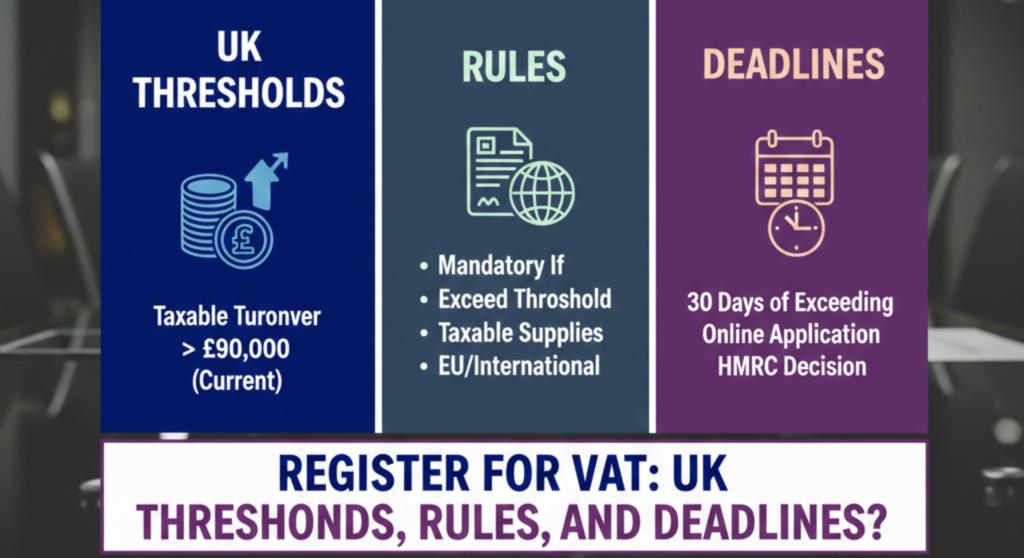
Your business must meet certain vat registration thresholds to use any scheme. The current threshold is £85,000 in taxable turnover. If you go over this, you must register.
Each scheme has its own eligibility limits, which are different from the general threshold:
- Cash Accounting Scheme: £1.35 million turnover limit
- Annual Accounting Scheme: £1.35 million turnover limit
- Flat Rate Scheme: £150,000 turnover limit
- Retail Schemes: Various limits depending on the specific scheme type
It’s important to watch your turnover closely. If you go over your scheme’s limit, you must switch to standard VAT accounting. This change needs careful planning to avoid problems.
Using a VAT Calculator to Determine Your Best Option
A vat calculator makes complex numbers easy to understand. Just enter your input VAT, output VAT, and annual turnover to see which scheme saves you money.
Use real examples with your business data. Think about these when calculating:
- Your monthly or quarterly VAT liability under standard accounting
- The flat rate percentage for your industry sector
- Your cash flow timing and payment patterns
- Administrative time savings under different schemes
HMRC offers guidance and online tools to help estimate outcomes. Try different scenarios to find the scheme that saves you the most money and fits your admin style.
How to Apply for and Switch Between HMRC VAT Schemes
Starting a new VAT scheme or switching is easier than you think. HMRC has made the application process simple for business owners. Knowing the steps helps you move between schemes without affecting your business.
You can apply for most VAT schemes online through your VAT account. Or, you can use paper forms if you prefer. The choice depends on the scheme and your VAT status.
Application Methods for Different Schemes
Each VAT scheme has its own application method. Here’s what you need to know:
- Cash Accounting and Annual Accounting – Complete form VAT600 or apply online
- Flat Rate Scheme – Use form VAT600 FRS or apply online
- Retail Schemes – Notify HMRC in writing with details of your chosen scheme
When you join a scheme, timing is important. Some schemes start right away, while others need you to apply before the next VAT period. Make sure you meet the specific requirements to avoid delays.
Switching and Leaving Schemes
Switching between VAT schemes involves telling HMRC you want to change. You’ll need to adjust your calculations, especially for transactions around the change date.
| Scheme Change Scenario | Key Consideration |
|---|---|
| Flat Rate to Standard Accounting | Input VAT reclaim starts from the change date, not before |
| Cash Accounting to Flat Rate | Payment rules change from cash to turnover basis |
| Annual Accounting to Standard | You’ll need to switch to quarterly or monthly returns |
| Any scheme exceeding turnover limits | You must leave schemes like Flat Rate or Cash Accounting |
Leaving a scheme is either by choice or due to rules. You must exit if you go over turnover limits or don’t meet the rules. If a scheme doesn’t work for you, you can ask to leave by contacting HMRC.
Switching schemes is easy compared to the benefits. The right scheme saves you money and reduces paperwork all year.
Conclusion
Choosing the right VAT accounting schemes is crucial for your business. It impacts your cash flow and how much work you do. You’ve learned that while standard VAT accounting is common, HMRC has other options.
The Cash Accounting scheme is good for businesses that let customers pay later. The Flat Rate scheme is simple and works well for small traders. Retail schemes are for specific retail businesses. Annual Accounting means you file fewer returns each year.
What scheme you choose depends on your business’s needs. Consider your turnover, if you let clients pay later, your VAT on purchases, and your business type. What’s best for one business might not be for another. You should check your VAT method often as your business changes.
Some schemes can be used together, like Annual Accounting with Cash Accounting. This can help your business more. Before switching, think about the financial effects. Check if you meet the criteria for each scheme.
HMRC has tools and resources to help you decide. Use a VAT calculator to see potential savings. If unsure, talk to an accountant or tax adviser. Choosing wisely can improve your cash flow, reduce work, and lower VAT costs. It also ensures you follow UK tax laws.