Are you wondering if your business needs to register for VAT in the UK? You might feel unsure about what to do next. But, the VAT registration process doesn’t have to be hard.
VAT registration is a big step for growing businesses in the UK. It’s important whether you’re hitting the mandatory threshold or want to register voluntarily. This guide will cover everything you need to know about the vat registration process.
Every business owner wants to follow HMRC rules and make the most of their finances. Knowing how to register for VAT in the UK is key. It helps you run your business smoothly and shows you’re professional.
In this article, we’ll explain the VAT registration rules and the main steps. You’ll learn how to understand VAT thresholds and how to apply. By the end, you’ll know how to make smart choices for your business.
Understanding VAT and Why Your Business Needs It
Getting to grips with VAT can seem daunting, but it’s vital for UK businesses to grow. Value Added Tax (VAT) is a tax on most goods and services sold in the UK.
VAT is a pass-through tax. Businesses collect tax from customers and then send it to HMRC. This way, the tax falls on the consumer, not the business.
What Is VAT and How Does It Work?
VAT is simple. When your business hits a certain sales mark, you must sign up for VAT. The UK’s standard VAT rate is 20%. Some items get a lower rate:
- Standard rate: 20%
- Reduced rate: 5%
- Zero rate: 0%
Benefits of VAT Registration for Growing Businesses
Registering for VAT has many pluses for growing firms. It lets you get back VAT on business buys and boosts your image. This can help with suppliers and customers, who see VAT registration as a sign of seriousness.
Key benefits include:
- Reclaiming VAT on business expenses
- Increased business legitimacy
- Potential cash flow advantages
- Easier trading with other VAT-registered businesses
Determining If You Need to Register for VAT in the UK
Knowing when to register for VAT is key for your business’s finances. The UK VAT threshold is important in deciding if you must or can choose to register.
Several factors influence your VAT registration decision:
- Your business’s total taxable turnover
- The type of goods and services you provide
- Your current business structure
- International trading activities
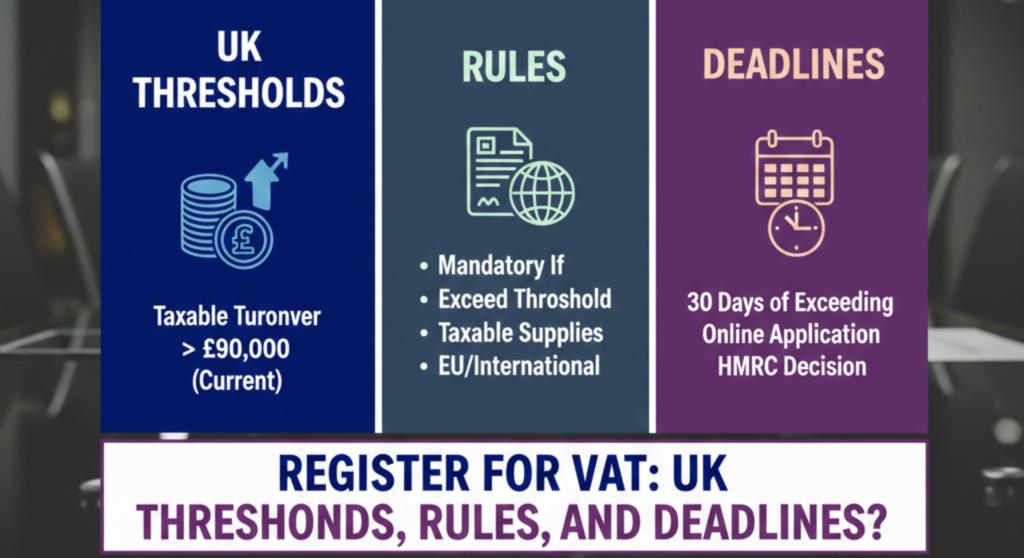
Reaching the UK VAT threshold is the main reason for mandatory VAT registration. If your taxable turnover goes over £85,000 in a year, you must sign up for VAT with HM Revenue and Customs (HMRC).
Some situations might need VAT registration even before hitting the threshold:
- Receiving goods from EU countries
- Acquiring services from overseas businesses
- Operating within certain specialised industry schemes
Keeping an eye on your turnover is crucial for on-time and correct VAT registration. Not registering when needed can lead to big fines and legal issues.
But VAT registration isn’t always a must. Some businesses register voluntarily to get back input tax and look more professional.
The UK VAT Threshold: When Registration Becomes Mandatory
Knowing the UK VAT threshold is key for business owners. It tells you when you must sign up for value-added tax with HMRC.
As a business owner, it’s important to know the VAT registration rules. The UK VAT threshold is a financial mark that affects your tax duties.
Current VAT Threshold Limits
The UK VAT threshold is now £85,000 for a year. You must register for VAT if your sales:
- Have been over £85,000 in the last 12 months
- Will be over £85,000 in the next 30 days
Calculating Your Taxable Turnover
Working out your taxable turnover needs careful thought. You must include:
- All standard-rated sales
- Zero-rated supplies
- Certain exempt supplies
Don’t count:
- Zero-rated goods sold outside the EU
- Sales that are VAT-free
- Sales of capital assets
Pro tip: Keep detailed financial records to accurately track your turnover and VAT threshold status.
Watching your business income closely keeps you in line with HMRC rules. It also helps avoid fines for late registration.
Voluntary VAT Registration: Is It Right for Your Business?
Deciding on voluntary VAT registration can be a smart move for your business. It’s different from mandatory registration. Voluntary VAT registration lets businesses below the legal threshold choose to register.
Think about voluntary VAT registration if your business fits certain criteria. The main benefits are:
- Reclaiming VAT on business purchases and expenses
- Improving professional credibility
- Competing better with VAT-registered businesses
- Showcasing business growth potential
Your choice should weigh the good points against the extra work. Voluntary VAT registration means:
- Charging VAT on sales to customers
- Submitting regular VAT returns
- Keeping detailed financial records
- Potential effect on pricing strategies
Businesses with a lot of input VAT and sales to VAT-registered customers usually gain the most. Examine your financial situation carefully before making this big decision.
Look at your yearly sales, customer base, and tax savings. Some businesses see voluntary VAT registration as a money-saver. Others might find it too much work.
Preparing Your Business Information for HMRC VAT Application
Preparing for your HMRC VAT application needs careful planning. You must gather the right documents and financial records. This will make your registration smoother and avoid delays.
Essential Documents for Your VAT Registration
Before you start your HMRC VAT application, get these important documents:
- Business registration details
- Unique Taxpayer Reference (UTR)
- Business bank account information
- National Insurance number
- Detailed business activity descriptions
Organising Your Financial Records
Good financial record management is key for a smooth HMRC VAT application. Your documents should show your business’s financial health clearly.
| Record Type | What to Include |
|---|---|
| Sales Records | Invoices, receipts, sales ledgers |
| Purchase Records | Expense receipts, supplier invoices |
| Financial Statements | Profit and loss reports, balance sheets |
Keeping organised and accurate financial records supports your VAT application. It also helps you manage your business finances better.
Register for VAT in the UK: Step-by-Step Guide
Starting the VAT registration process in the UK might look hard at first. But breaking it down into simple steps makes it easier. It’s key for your business to know how to register for VAT in the UK.
Before you start, get all your business documents and financial records ready. This will help make your application smoother and avoid delays.
- Check if your business needs to register for VAT
- Get your business’s financial info ready
- Choose the right VAT accounting scheme for you
- Fill out the online form on HMRC’s website
- Submit your application and wait for confirmation
The VAT registration process needs your full attention. You’ll have to give lots of details about your business, such as:
- Details of your business’s turnover
- Your company’s registration number
- Your contact information
- Your bank account details
- An estimate of your VAT taxable turnover
| Registration Method | Processing Time | Complexity |
|---|---|---|
| Online HMRC Portal | 7-14 working days | Low |
| Paper Application | 30-45 working days | High |
When you register for VAT in the UK, you get a special VAT number. Make sure to keep this number safe. You’ll need it for all VAT-related stuff in the future.
Navigating the Online VAT Registration Process
Registering for VAT online with HMRC might seem hard, but it’s easy once you know the steps. The online system makes it quick and simple to register your business for tax.
Before starting, you need some important information ready. Having these details ready will make the HMRC VAT application smoother.
Creating Your Government Gateway Account
To start your VAT registration online, first create a Government Gateway account. This digital portal is your main way to deal with HMRC online.
- Visit the official HMRC website
- Click on ‘Create sign-in details’
- Provide your email address
- Choose a strong, unique password
- Complete the identity verification process
Completing the VAT1 Form Online
With your Government Gateway account ready, you can start your VAT registration. The VAT1 form asks for lots of details about your business.
- Log in to your Government Gateway account
- Navigate to the VAT registration service
- Select ‘Register for VAT’
- Enter your business details carefully
- Review all information before submission
The VAT registration online usually takes about 30 minutes. Make sure you have all your business documents ready to make the process easier.
Choosing the Right VAT Scheme for Your Business
Finding the right VAT scheme in the UK can be tough for business owners. Knowing about the different VAT options helps you pick the best one for your business.
The UK has several VAT schemes to make tax easier and cut down on paperwork. Each scheme has its own benefits that might suit your business better.
- Flat Rate Scheme: Great for smaller businesses with turnover under £150,000
- Cash Accounting Scheme: Best for managing cash flow issues
- Annual Accounting Scheme: Reduces paperwork with fewer VAT returns
- Retail Scheme: Specialised for businesses selling directly to consumers
Choosing the right VAT scheme in the UK depends on several key factors. These include your business size, industry, and how you manage your finances.
| VAT Scheme | Best For | Key Benefits |
|---|---|---|
| Flat Rate | Small businesses | Simplified tax calculations |
| Cash Accounting | Businesses with cash flow issues | Pay VAT when payment received |
| Annual Accounting | Businesses seeking reduced admin | One annual VAT return |
Your chosen VAT scheme can greatly affect your financial plans. It’s wise to talk to a tax expert to find the best option for your business.
What Happens After You Submit Your Application
After you send your VAT registration to HMRC, you’ll wait. This time can be both thrilling and a bit scary for your business. Knowing what to expect can help you stay calm and ready for what comes next.
Getting your VAT number UK involves a few important steps. Online applications usually go faster than paper ones, taking 1-3 weeks. HMRC checks your application to make sure everything is correct.
Tracking Your Application Status
You can see how your VAT registration is doing on your Government Gateway account. While you wait, HMRC might:
- Ask for more documents
- Check your business details
- Look at your taxable turnover
- Understand your business structure
Receiving Your VAT Number
When HMRC says yes, they’ll send you a VAT registration certificate with your unique nine-digit VAT number UK. This certificate is very important for your business records. Make sure to keep it safe.
Your VAT registration will start on a specific date. This is when you must start charging VAT on your sales and can claim back VAT on what you buy. You’ll need to update your invoices, website, and business materials with this new number.
Understanding Your VAT Obligations for Businesses
When you register for VAT, your business has key responsibilities. It’s vital to understand vat obligations for businesses to follow HMRC rules. These duties are not just about registering; they need constant focus on financial details.
Your main VAT duties include:
- Charging the right VAT rate on taxable supplies
- Issuing accurate VAT invoices with all necessary details
- Keeping detailed financial records for at least six years
- Submitting VAT returns on time, every quarter
- Paying VAT to HMRC without delay
Businesses must use Making Tax Digital (MTD) software if their turnover hits certain levels. This digital method makes VAT reporting easier and cuts down on mistakes.
Managing VAT means knowing about input and output VAT. Input VAT is what you pay on business buys, while output VAT is what you charge customers. Keeping these accounts balanced is key for accurate financial reports and avoiding fines.
It’s not just about avoiding fines. It’s about showing your business is professional and transparent with its finances.
Common Mistakes to Avoid During UK Tax Registration
Getting through uk tax registration can be hard for many businesses. Knowing the common mistakes can save you time, money, and stress. It makes the VAT registration process smoother.
Businesses often make critical errors that slow down their application. By understanding these mistakes, you can avoid them and register efficiently.
Critical Mistakes in VAT Registration
- Missing the mandatory registration deadline
- Providing incomplete financial documentation
- Incorrectly calculating taxable turnover
- Selecting inappropriate VAT schemes
- Submitting inconsistent business information
Specific Registration Errors to Prevent
Your success in uk tax registration depends on careful preparation. Some common issues include:
- Mismatched business details across HMRC records
- Unclear business activity descriptions
- Incorrect bank account information
- Technical submission problems
To avoid problems, double-check all your information. If unsure, consider getting professional help.
| Error Type | Potential Consequence | Prevention Strategy |
|---|---|---|
| Missed Deadline | Financial Penalties | Register within 30 days of threshold |
| Incomplete Records | Application Rejection | Prepare comprehensive financial documentation |
| Incorrect Turnover | Registration Delay | Carefully calculate taxable sales |
Being proactive in preparation can help avoid many challenges. This ensures a smooth uk tax registration process for your business.
Conclusion
Registering for VAT in the UK might seem hard, but it’s doable with the right info. Knowing when and how to register helps you follow the rules and find new business chances.
For a smooth VAT registration, plan well. Keep an eye on your business’s income, collect all needed documents, and pick the best VAT scheme for you. Breaking it down into smaller steps makes it easier.
VAT registration is more than just following the law. It shows your business is growing and serious. If you’re unsure, get help from a tax expert. They can give advice that fits your business.
Being confident and thorough in your VAT registration sets you up for success. This way, your business stays on the right track and might even gain financially.