Are you missing out on thousands of pounds by not knowing about business VAT recovery? Many UK business owners don’t claim back VAT on legitimate expenses. This is often because they’re not sure about the rules or haven’t organised their paperwork right.
Reclaiming VAT on business purchases can greatly improve your cash flow and cut down on costs. When you’re VAT-registered, you pay tax on what you buy. The good news is you can get this VAT back from HMRC through a set process.
But reclaiming VAT isn’t automatic. You must follow certain rules, keep accurate records, and know which expenses qualify. Doing this right means more money stays in your business. Doing it wrong can lead to penalties and issues with HMRC.
This guide will cover everything you need to know about reclaiming VAT on business purchases. You’ll learn which expenses qualify, how to claim them, and common mistakes to avoid. By the end, you’ll be confident in managing your VAT reclaims and ensure your business gets every penny it’s owed.
Understanding VAT and Your Business Obligations
Value Added Tax (VAT) is a key part of the UK tax system. As a business owner, knowing how VAT works is crucial. It helps you manage your finances and claim tax relief on business purchases.
What is Value Added Tax?
VAT is an indirect tax on most goods and services in the UK. HMRC sets the rates, which are:
- 20% standard rate on most goods and services
- 5% reduced rate on specific items like fuel and energy
- 0% zero rate on certain products, including food and books
Businesses collect tax for HMRC. You charge VAT to customers and then give the money to HMRC after claiming back VAT on costs.
How VAT Applies to Business Transactions
As a VAT-registered business, you handle two VAT types:
- Output VAT: The tax you charge customers on sales
- Input VAT: The tax you pay on business purchases
The input vat deduction system lets you reclaim input tax on expenses. You subtract input VAT from output VAT and send HMRC the difference. This avoids VAT burden on businesses.
Your main duties include charging the right VAT rates, issuing proper invoices, keeping records, and submitting VAT returns to HMRC. Knowing these basics helps you manage input tax and claim what you’re owed.
Reclaiming VAT on Business Purchases
If you’re a VAT-registered business in the UK, you can get back VAT on business purchases. This lets you claim back the VAT paid on goods and services used for work. Knowing how to do this is key to managing your business’s money well.
When you buy things for your business and get a VAT invoice, you can ask HM Revenue and Customs (HMRC) for the VAT back. This way, VAT only goes to the final buyer, not businesses in the middle. If you get more VAT back than you pay out, you might even get a refund.
Getting VAT back can really help your business’s money flow, especially for big buys. For instance, a company buying new machines or a consulting firm getting software can save a lot.
But you can’t just get VAT back for anything. HMRC has rules and limits on what you can claim. You need to:
- Be properly registered for VAT
- Have valid VAT invoices from suppliers
- Show that the purchases were for business use
- Submit your VAT returns on time
- Keep accurate records
Knowing how to claim back VAT puts you in a better position to make your business more financially efficient. The next part will look at what you need to do to get VAT back on your purchases.
Eligibility Criteria for VAT Recovery
Before you try to get back VAT on business buys, it’s key to know the rules. HMRC sets out what you need to do to claim back VAT. These rules help make sure your claims are right and avoid costly mistakes.
VAT Registration Requirements
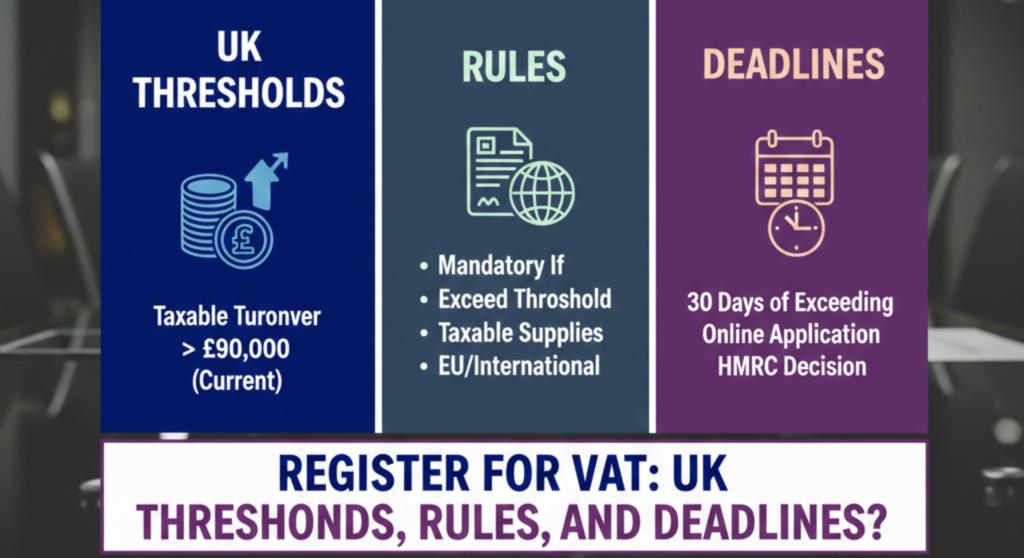
To start claiming back VAT, you must first register with HMRC. You need to do this if your sales are over £85,000 in a year. Or, you can sign up early if your sales are less, which helps if you buy a lot of VAT items.
Only businesses that are VAT-registered can get back VAT on what they buy. To register, you fill out an online form with HMRC. You’ll need to give details about your business, what you do, and your bank info. Once you’re approved, you get a special VAT number.
It’s important to know that you can only get back VAT on things you buy after you register. There are some exceptions for things you bought before, depending on your situation.
| Registration Factor | Details |
|---|---|
| Turnover Threshold | £85,000 within any 12-month period |
| Voluntary Registration | Available below the threshold |
| Registration Number | Unique identifier issued by HMRC |
| Reclaim Start Date | From your official registration date onwards |
| Application Method | Online through the HMRC portal |
Business Purpose Test
The business purpose test checks if your buys are really for your business. HMRC looks closely at this. Your items or services must be only for your business and for making taxable sales.
Items used for both work and personal use need careful handling. You can only get back VAT on the work part. For example, if you use a car 70% for work and 30% for yourself, you can only claim VAT on 70% of the cost.
- Purchases must serve your business directly
- Items used for personal benefit typically fail the test
- Mixed-use expenses need documented allocation
- Entertaining clients generally doesn’t qualify for reclaim
- Equipment for business operations qualifies fully
Having the right documents is key to proving your claims. You need VAT invoices from your supplier with certain details:
- Supplier’s full VAT registration number
- Clear description of goods or services provided
- Invoice date and unique reference number
- Your business name and address
- VAT amount charged separately
- Total price including VAT
Meeting both vat reclaim eligibility criteria—proper registration and legitimate business purpose—protects your VAT recovery claims and keeps your records compliant with HMRC regulations.
Allowable Business Expenses for VAT Reclaim
In the UK, knowing which business purchases you can claim VAT back on is key. HMRC lets you reclaim VAT on many business purchases, as long as they’re for business use only. You must keep records to prove this.
Many things are covered in business expense vat claims. This includes stock, raw materials, and office items like computers and furniture. You can also claim back VAT on professional services and utility bills.
Business travel, rent, and software subscriptions are also included. These help your business run smoothly and can save you money.
| Expense Category | VAT Reclaim Eligibility | Key Requirements |
|---|---|---|
| Raw materials and stock | Fully recoverable | Must be for resale or manufacturing |
| Office equipment and supplies | Fully recoverable | Business use only |
| Professional services | Fully recoverable | Invoice required from the supplier |
| Utility bills | Fully recoverable | Business premises only |
| Business travel costs | Fully recoverable | Directly related to business |
| Software subscriptions | Fully recoverable | Business uses documented |
For successful VAT claims, keeping good records is crucial. Each purchase must be for business use only. You need VAT invoices from suppliers when you file your VAT return.
It’s important to show that costs are needed for your business. This rule helps decide what expenses you can claim back. Keeping detailed records helps you make the most of VAT claims and improve your business’s finances.
The VAT Reclaim Process Step-by-Step
Managing your vat reclaim process well needs clear organisation and knowing HMRC rules. This guide will show you how to get back VAT on your business buys. You’ll learn how to gather, sort, and send in your claims the right way.
Collecting and Organising VAT Receipts
Your vat reclaim journey starts with the right documents. Every VAT invoice must have certain details for a valid claim:
- Supplier’s name, address, and VAT registration number
- A unique invoice number
- The tax point (date of supply)
- Your business name and address
- Description of goods or services purchased
- Total amount excluding VAT
- VAT rate applied
- VAT amount charged
Keep receipts for at least six years as HMRC asks. Don’t use simplified receipts for full recovery. Store VAT invoices separately. Using accounting software like Xero or FreshBooks can help scan and sort invoices for you. Digital storage keeps your documents safe and makes the process easier.
Completing Your VAT Return
Your vat reclaim journey goes on with VAT return submissions. You can claim VAT quarterly, monthly, or annually, depending on your business. Use HMRC’s Making Tax Digital system to do returns online.
Focus on Box 4 of your VAT return form. This box shows your total input VAT for recovery. Your output VAT is shown separately. HMRC will then work out if you owe money or get a refund. Make sure all numbers are correct before you submit to avoid delays. Submit on time to keep your vat reclaim process running smoothly.
| Return Frequency | Best For | Filing Deadline |
|---|---|---|
| Quarterly | Standard businesses | One month after quarter end |
| Monthly | High-turnover businesses | Five working days after the month end |
| Annual | Smaller businesses | Within nine months of year end |
Your vat reclaim process ends when HMRC processes your return. Refunds usually come within 30 days. This lets your business get back valuable cash from qualifying purchases.
Common Purchases Where You Can Recover VAT
Knowing which business purchases qualify for VAT recovery is key to saving tax. By recovering VAT on purchases, you get back the tax paid on items for business use. This section looks at everyday expenses where you can get back all the VAT, helping you spot chances in your work.
Your office has many items where you can get back VAT. This includes computers, furniture, and stationery. You can get back 100% VAT on these items if they’re only for work.
Stock and inventory purchases are big chances, too. Raw materials, parts, and finished goods for selling or making things qualify. You can get back VAT on these, cutting down your business costs.
Professional services also offer big chances for VAT recovery. This includes accountants, lawyers, consultants, and IT support. The VAT on their fees can be claimed back.
| Expense Category | VAT Recovery Status | Key Examples |
|---|---|---|
| Premises and Utilities | Fully Recoverable | Commercial rent, repairs, maintenance, electricity, water, business rates |
| Technology and Communications | Fully Recoverable | Internet, mobile contracts, website hosting, accounting software, CRM systems |
| Commercial Vehicles | Fully Recoverable | Vans, lorries, trucks, fuel, maintenance, repairs |
| Business Travel | Fully Recoverable | Train tickets, air travel, hotel stays, conference fees |
Expenses related to your business property offer steady chances for VAT recovery. This includes rent, rates, repairs, and utility bills. These ongoing costs greatly benefit from VAT claims.
Technology costs are growing. Internet, mobile contracts, and software all allow VAT recovery. This includes accounting and CRM systems.
Commercial vehicles also offer clear benefits. Vans, lorries, and trucks, along with their fuel and maintenance, qualify for full VAT recovery. Cars for business use have different rules.
- Business travel expenses qualify for recovery
- Train and air fares for work purposes are reclaimable
- Hotel accommodation during business trips allows VAT recovery
- Conference and trade show attendance fees carry recoverable VAT
Business travel is another area for VAT recovery. Train fares, air tickets, and hotel stays for work trips are all recoverable. So are fees for conferences and trade shows.
Spotting these chances in your business helps you make the most of VAT recovery. Regular checks of your purchases against these categories help avoid missing out on claims.
Expenses Where Input VAT Deduction is Restricted
Not all business purchases get a full VAT refund. HMRC has strict rules to stop misuse of the VAT system. Knowing these rules helps avoid costly mistakes and keeps your business in line.
Some expenses get only partial refunds, while others are not refundable at all. Understanding which expenses you can claim for is key to protecting your business’s finances and ensuring accurate VAT reports.
Entertainment and Hospitality Limitations
HMRC doesn’t allow VAT refunds for entertainment for clients, customers, or suppliers. This includes meals, drinks, and tickets to events. The reason is simple: entertainment is seen as a benefit, not a standard business activity.
However, staff entertainment is different. If you treat your employees to meals or events, you might be able to claim back the VAT. This is because such events are part of the employment relationship.
Make sure to keep your records clear:
- Client entertainment—VAT cannot be recovered
- Staff entertaining—VAT may be recoverable
- Mixed events—apportion costs accordingly
Personal Use Adjustments
Assets used for both business and personal reasons can be tricky. You can only claim VAT on the business-use percentage of these items.
Examples include:
- Vehicles used for both work and personal trips
- Mobile phones for both business and personal calls
- Home office expenses for both work and home use
- Equipment used for both business and personal activities
Calculate your business-use percentage fairly and document your reasons. For example, if your vehicle is 60% for business, you can only claim VAT on 60% of the cost. If personal use goes up, you must adjust your claim accordingly.
Some items, like most cars, can’t have VAT refunded. But, some commercial vehicles might qualify. Also, there are limits on claiming VAT for business travel accommodation, with some exceptions for staff training.
Being cautious with your claims is wise, especially with mixed-use items. Keeping accurate records is crucial in case of HMRC checks.
Using a VAT Calculator to Determine Your Refund
Figuring out your VAT refund can be tricky, especially when receipts don’t show the tax clearly. A vat calculator makes this easier. You can use online tools, spreadsheets, or accounting software to find out how much VAT you can get back on your business buys.
VAT calculations involve different rates and finding the tax in gross amounts. The standard rate is 20%, but you might see 5% or 0% rates too. To find the gross amount from the net price, multiply by 1.20. To get VAT from a taxed price, divide by 1.20 or multiply by 20/120.
- When receipts don’t separate the VAT amount clearly
- When you need to verify suppliers charged the correct VAT rate
- When you’re budgeting and need to understand true costs
- When estimating your quarterly or monthly VAT position
Your vat calculator also helps you predict your vat refund. It compares your input VAT to your output VAT. This shows your cash flow before you file your VAT return.
Remember, calculators are just tools to check your numbers. They don’t replace proper invoices and records. They help make sure your VAT recovery plan is on track.
Avoiding Common Mistakes in Business VAT Recovery
Many businesses make costly errors when pursuing business VAT recovery. These mistakes can lead to incorrect VAT claims, HMRC penalties, and time-consuming corrections. Understanding what to avoid helps you protect your business and maintain compliance with UK tax regulations.
One of the most frequent errors involves claiming VAT without valid documentation. You must always obtain a proper VAT invoice from registered suppliers. Using simplified receipts or invoices from non-VAT-registered businesses will not qualify for business VAT recovery. Additionally, claiming VAT on expenses before your VAT registration date is restricted, except for specific allowable pre-registration purchases.
Another common mistake centres on blocked expenses. You cannot recover VAT on client entertainment, personal vehicle use, or certain mixed-use assets. Failing to adjust for personal or private use of business equipment significantly weakens your business VAT recovery claims. Poor record-keeping also creates serious problems during HMRC inspections.
Your record-keeping matters greatly for defending your business VAT recovery position. Keep these practices in mind:
- Maintain original VAT invoices and receipts for all purchases
- Reconcile purchase records with bank statements regularly
- Use accounting software to track eligible expenses
- Document personal use adjustments clearly
- Meet the four-year deadline for claiming VAT on returns
If you discover errors in previous returns, correct them promptly using appropriate methods. Small errors can be adjusted in your next return, whilst larger discrepancies require a separate HMRC notification. Aggressive VAT planning rarely benefits your business and risks substantial penalties, reputational damage, and increased scrutiny.
Being honest and transparent with your business VAT recovery claims builds trust with HMRC. When uncertainty exists about whether an expense qualifies, seek professional advice rather than guessing.
Conclusion
Reclaiming VAT on business purchases is a vital right for UK VAT-registered businesses. Understanding the rules and following the right steps can boost your cash flow. This guide has equipped you to claim every penny you deserve.
To succeed in reclaiming VAT, focus on a few key areas. Keep your VAT registration up to date and ensure all purchases are for business use. Your records must be accurate and complete, with valid VAT invoices.
Knowing which expenses you can claim and which have restrictions is crucial. File your VAT returns on time and adjust for personal use. Tools like Sage 50 or QuickBooks can make tracking easier.
See VAT reclaim as a chance to grow, not a hassle. Good record-keeping and accounting tech simplify the process. If you face challenges, a qualified accountant can help keep you compliant with HMRC.
With the steps from this guide, you’re ready to reclaim VAT with confidence. You’ll improve your finances and secure a strong future for your business. Learning VAT recovery is a smart investment in your financial skills.